What does the latest AI news mean for users of Grok Bot, ChatGPT, Claude and Gemini?
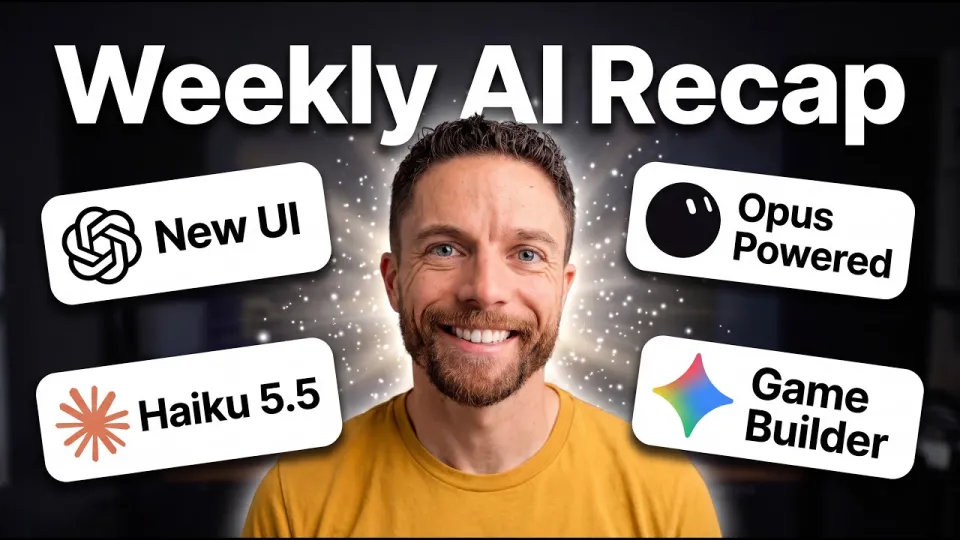
Video: Weekly AI Recap: GrokBot Just Did the Unthinkable, ChatGPT Looks Completely Different & More!
Need articles like this for your video? They help promote it on YouTube and Google — order them in the Telegram bot @sat_sit_bot. The bot writes and publishes the articles itself (with your YouTube video embedded) on popular topical websites (no ads). Free trial — 50 articles.
· based on the channel Paul J Lipsky
Key takeaways
- Grok Bot is planning to draw on Claude, Midjourney and Suno, turning it from a chat assistant into a multi-tool workspace.
- ChatGPT is rolling out a new Intelligent UI that changes how the interface looks and how it routes requests.
- Claude Cowork is moving to the cloud, which makes shared agent work less dependent on one local machine.
- Google is testing Playground and changing Gemini plans, while Nano Banana 2.1 updates its image generation.
- Paul J Lipsky's weekly recap is the source for this roundup, with a sponsored segment from Okou.
The latest AI news centers on Grok Bot's plan to use Claude, Midjourney and Suno, ChatGPT's new Intelligent UI, Claude Cowork moving to the cloud, and Google's Gemini plan changes alongside the Nano Banana 2.1 image model. These updates matter because they shift AI assistants from single chat windows into multi-tool workspaces, and viewers can try the sponsor's platform through Okou's registration page. The roundup below explains what changed and what it means in practice.
What changed in this week's AI news
This week's AI news is best read as a set of product moves rather than a single announcement. Grok Bot is the headline: the assistant is reportedly planning to use Claude, Midjourney and Suno inside its workflow. That means a user could ask for reasoning or writing help, image generation and music generation without leaving the same assistant. ChatGPT, meanwhile, is getting a new Intelligent UI, which changes the look of the product and how it presents tools to users. Anthropic is pushing Claude Cowork toward the cloud, and Google is adjusting Gemini plans while testing Playground and shipping Nano Banana 2.1. The common thread is consolidation: assistants are becoming front ends for several models and services rather than one model with one chat box.
Grok Bot's plan to use Claude, Midjourney and Suno
Grok Bot's reported plan is to route work to outside models and creative tools instead of relying only on its own model. The three names attached to the plan are Claude for reasoning and text work, Midjourney for image generation and Suno for music. In practice, that would let a single assistant handle a request like "write a script, generate a cover image and produce a short track" without the user opening three separate products. The strategic logic is simple: users care about the result, not which model produced it, so an assistant that can call the best tool for each job can win on convenience. The risk is equally clear. Routing between vendors adds latency, cost and dependency on third-party terms, and it makes quality harder to predict because the same prompt may land on different models. For users, the practical test will be whether Grok Bot exposes which tool handled a task and whether it keeps outputs consistent across a project.
ChatGPT's Intelligent UI and what it changes
ChatGPT's Intelligent UI is a redesign that aims to make the product feel less like a blank chat box and more like a guided workspace. The interface is meant to surface the right tools and actions for the task at hand, so a user writing code, drafting a document or working with files sees different controls instead of the same empty prompt. That is a meaningful change because most assistant interfaces have stayed close to the original chat layout even as the underlying models gained tools, memory and file handling. A task-aware interface can reduce the gap between what the model can do and what users know to ask for. The trade-off is familiarity: users who have built habits around a simple prompt box may need time to adjust, and any interface that guesses intent can also guess wrong. The sensible approach is to treat the new layout as a default, not a lock, and keep using explicit prompts when precision matters.
Claude Cowork moves to the cloud
Claude Cowork moving to the cloud is a shift from local, machine-bound collaboration toward shared work that runs remotely. Cowork is designed for agent-style tasks where Claude works alongside a person on documents, research and multi-step jobs. Running that in the cloud means the work is less tied to one laptop being open and can be shared across a team. For individuals, the benefit is continuity: a long task can keep running while you do something else. For teams, the benefit is coordination, since several people can point at the same work instead of passing files around. The questions to watch are access control, data retention and how clearly the product shows what the agent did versus what a human approved. Cloud execution also raises the bar for permissions, because an agent with access to shared files has a wider blast radius than one working on a single local folder.
Google's Gemini plans, Playground and Nano Banana 2.1
Google's updates this week span pricing, testing and image generation. Gemini plan changes affect what subscribers get and at what tier, so anyone paying for Google's AI features should check which model and storage limits their plan now includes before renewing. Playground is Google's testing surface for new model behavior, and it is the place to look when you want to try features before they reach the main Gemini app. Nano Banana 2.1 is the updated image model, and each iteration tends to improve prompt adherence and editing consistency, which matters most when you need a specific composition rather than a lucky result. The practical takeaway is to separate three things that are easy to confuse: what you pay for, what you can test early, and what the image model can actually do. A plan change does not automatically mean better outputs, and a playground feature is not a promise of general availability.
Questions viewers keep asking about these AI updates
The most common questions around these updates are practical rather than technical. People want to know whether a new interface will break their existing workflows, whether cloud-based agents are safe for business files, and whether routing between models makes results less reliable. On Grok Bot, the recurring concern is control: if the assistant can call Claude, Midjourney and Suno, users want to know which service handled a request and what it cost. On ChatGPT, the concern is habit: a redesigned interface is welcome only if the old prompts still work. On Claude Cowork, the concern is access: who can see a shared task and how it is stopped. The honest answer to all three is to test on low-stakes work first, keep sensitive material out of shared agents until permissions are clear, and read the plan details before assuming a feature is included. A weekly recap is useful precisely because it groups these changes so you can spot which one affects you.
How to evaluate these AI releases without the hype
A useful way to judge any AI release is to ask three questions before changing your workflow. First, what job does it remove? If Grok Bot can produce a script, an image and a track in one session, the gain is fewer handoffs, not a better model. Second, what does it cost in money and control? Routing to Claude, Midjourney and Suno may raise subscription costs and reduce predictability. Third, what happens when it fails? An interface like ChatGPT's Intelligent UI should make recovery obvious, and a cloud agent like Claude Cowork should make stopping and auditing a task simple. Apply the same test to Gemini plans and Nano Banana 2.1: check the tier, test in Playground, and compare outputs on your own examples rather than a demo. Tools that pass these checks are worth adopting; tools that only look different are not.
Final thoughts on this week's AI roundup
This week's releases point in one direction: assistants are becoming orchestrators that call other models and creative tools, and the interface is becoming the product. Grok Bot's plan to use Claude, Midjourney and Suno, ChatGPT's Intelligent UI, Claude Cowork's move to the cloud and Google's Gemini and Nano Banana 2.1 updates all fit that pattern. The winners will be the tools that make routing transparent and failure easy to fix, not the ones with the longest feature list. Paul J Lipsky's weekly recap is a good place to follow these shifts as they land, and the sponsor's platform is available through Okou's sign-up page if you want to test a new AI workspace yourself.
Source: Weekly AI Recap: GrokBot Just Did the Unthinkable, ChatGPT Looks Completely Different & More! · Markdown version
Questions & answers
What is Grok Bot planning to use Claude, Midjourney and Suno for?
The plan is to let Grok Bot route different jobs to specialized tools: Claude for reasoning and text, Midjourney for images and Suno for music. That would turn it into a single front end for several services instead of one model. The practical benefit is fewer handoffs, while the trade-off is less predictable cost and quality.
Will ChatGPT's Intelligent UI break my existing prompts?
Your prompts should still work, because the Intelligent UI changes how tools and actions are presented rather than the underlying model. The bigger adjustment is habit: the interface may suggest actions you did not ask for. If precision matters, keep writing explicit instructions and treat the new layout as a default you can override.
Is Claude Cowork in the cloud safe for business documents?
Cloud execution makes shared agent work easier to coordinate, but it also widens access, so permissions matter more than before. Check who can view a task, what data is retained and how a running job is stopped. Start with low-stakes documents until those controls are clear.
Should I change my Gemini plan because of the latest updates?
Only after checking what your current tier includes, since plan changes affect model access and limits rather than guaranteeing better results. Use Playground to test new behavior and compare Nano Banana 2.1 outputs on your own examples. If your existing plan covers your workload, there is no rush to upgrade.